

Claude Haiku 5.5 gives developers a fresh reason to compare small models. Released on October 7, it reaches GPT-6 Luna’s short-context price level and posts higher scores in several comparisons published by Anthropic. The pricing match ends once prompts get long.
This is a launch analysis based on official sources checked on October 8, 2026. Mengbi has not run an independent API comparison. The useful decision is which model completes your recurring task at an acceptable cost, including retries and escalation.
What changed with Haiku 5.5?
The Haiku 5.5 model documentation lists a one-million-token context window, up to 128,000 output tokens and model ID claude-haiku-5-5. Its intended jobs include classification, extraction, routing and subagent work.
OpenAI describes Luna as a model for focused, high-volume work in its GPT-6 Sol and Luna introduction. The overlap makes this comparison relevant to support automation, document processing and agents that delegate smaller jobs.
For example, a document assistant can ask one model to identify the relevant passages before asking a larger model to write the answer. That is a proposed architecture, not evidence that either small model will retrieve the right passages in your application.
API pricing: identical starting rates, different thresholds
The following rates are in US dollars per million tokens, using standard API processing. They exclude batch discounts, regional premiums and separately billed tools.
| Model and prompt size | Input | Output | Cache reads |
|---|---|---|---|
| Haiku 5.5, up to 100,000 input tokens | $0.10 | $0.50 | $0.01 |
| Haiku 5.5, over 100,000 input tokens | $0.50 | $2.50 | $0.05 |
| GPT-6 Luna, up to 272,000 input tokens | $0.10 | $0.50 | $0.01 |
| GPT-6 Luna, over 272,000 input tokens | $0.20 | $0.75 | $0.02 |
Sources: Anthropic’s pricing documentation and OpenAI’s API pricing. The higher tier applies to the request, rather than only the tokens above the threshold. Context capacity and the cheap pricing tier are different limits.
Here are two illustrative budgets, assuming uncached input and the stated billable output counts:
- 10,000 classification requests: 2,000 input tokens and 200 output tokens each cost $3 on either model: $2 for input plus $1 for output.
- One long-document request: 150,000 input tokens and 2,000 output tokens cost $0.08 on Haiku and $0.016 on Luna. Haiku has crossed its higher-price threshold; Luna has not.
These are arithmetic examples, not measured bills. Providers can tokenize the same text differently, and reasoning, retries and tool calls can change usage. Compare recorded billable tokens rather than assuming identical token counts for identical documents.
Does “75% cheaper” mean every request saves 75%?
No. In its launch announcement, Anthropic estimates roughly 75% lower average task cost than Haiku 4.5. The per-token reductions are 90% for prompts up to 100,000 tokens and 50% above that threshold; the average also accounts for changed token usage. It is not a savings claim against Luna.
Benchmarks: what Anthropic’s comparison shows
The following figures are captures of Anthropic’s actual benchmark UI, checked on October 8, 2026. They retain the original labels and evaluation conditions. Select any image to open its full-resolution version. These are vendor-reported evaluations, not Mengbi’s own tests.
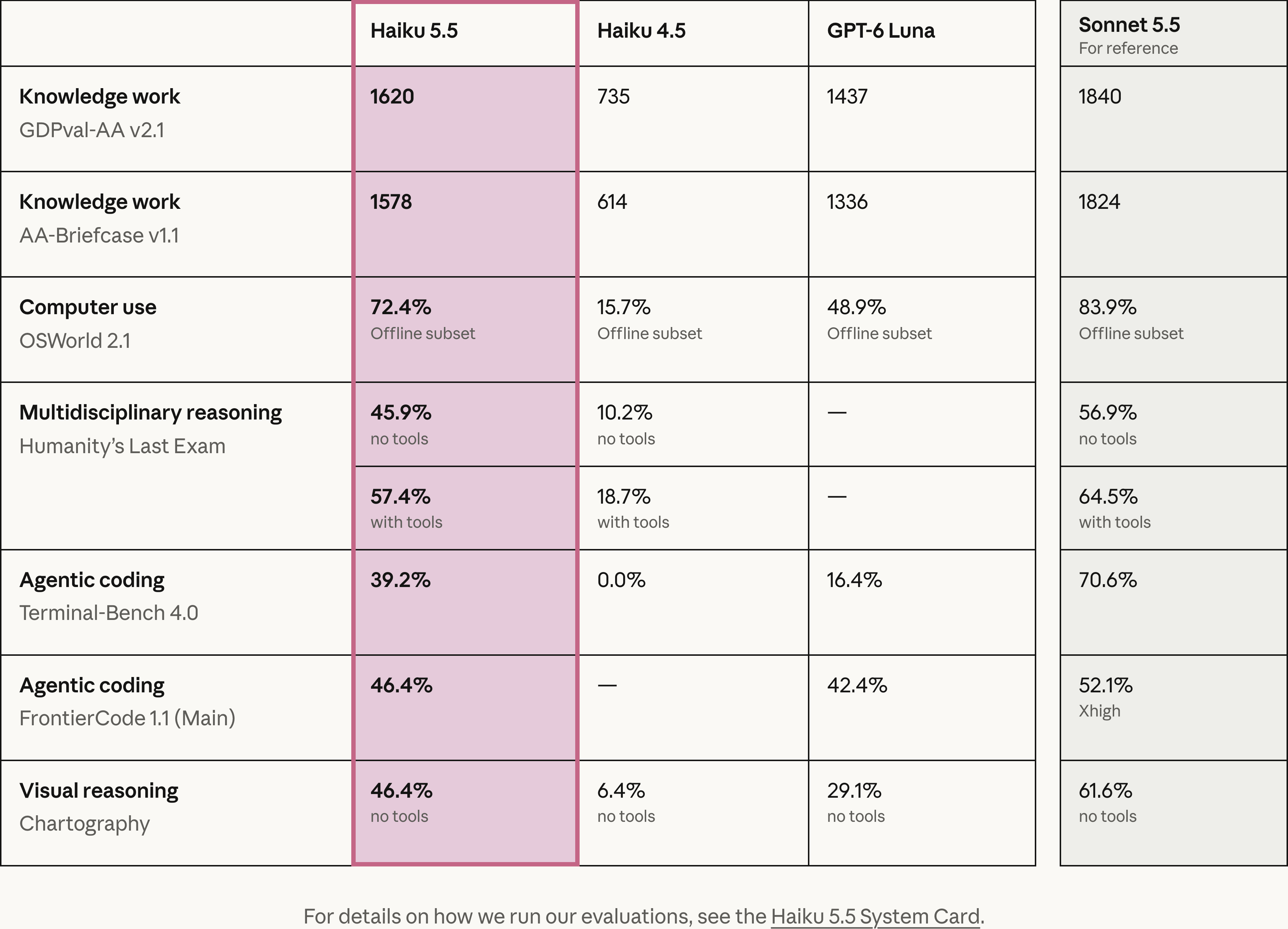
Source: Anthropic’s Haiku 5.5 announcement, Performance section. The original table distinguishes offline subsets, tool availability and Sonnet’s reference results. Evaluation details are in the linked Haiku 5.5 System Card.
These numbers come from the same Anthropic launch table. Higher is better within each row; the two knowledge-work scores are not percentages.
| Evaluation | Haiku 5.5 | GPT-6 Luna |
|---|---|---|
| GDPval-AA v2.1, knowledge work | 1620 | 1437 |
| AA-Briefcase v1.1, knowledge work | 1578 | 1336 |
| OSWorld 2.1, offline subset | 72.4% | 48.9% |
| Terminal-Bench 4.0, agentic coding | 39.2% | 16.4% |
The results favor Haiku on these evaluations. They do not establish a universal win in latency, Chinese writing or your own tool workflow. In particular, OSWorld’s offline subset is not a success rate for every website an agent might encounter.
For a deployment decision, keep the harness, tools, effort settings and task distribution attached to the score. A result obtained with a larger reasoning budget cannot establish what you will get at the cheapest setting. Use the published comparison to choose what to evaluate next, then test the actual requests your product sends.
OSWorld: the highest score uses a higher budget
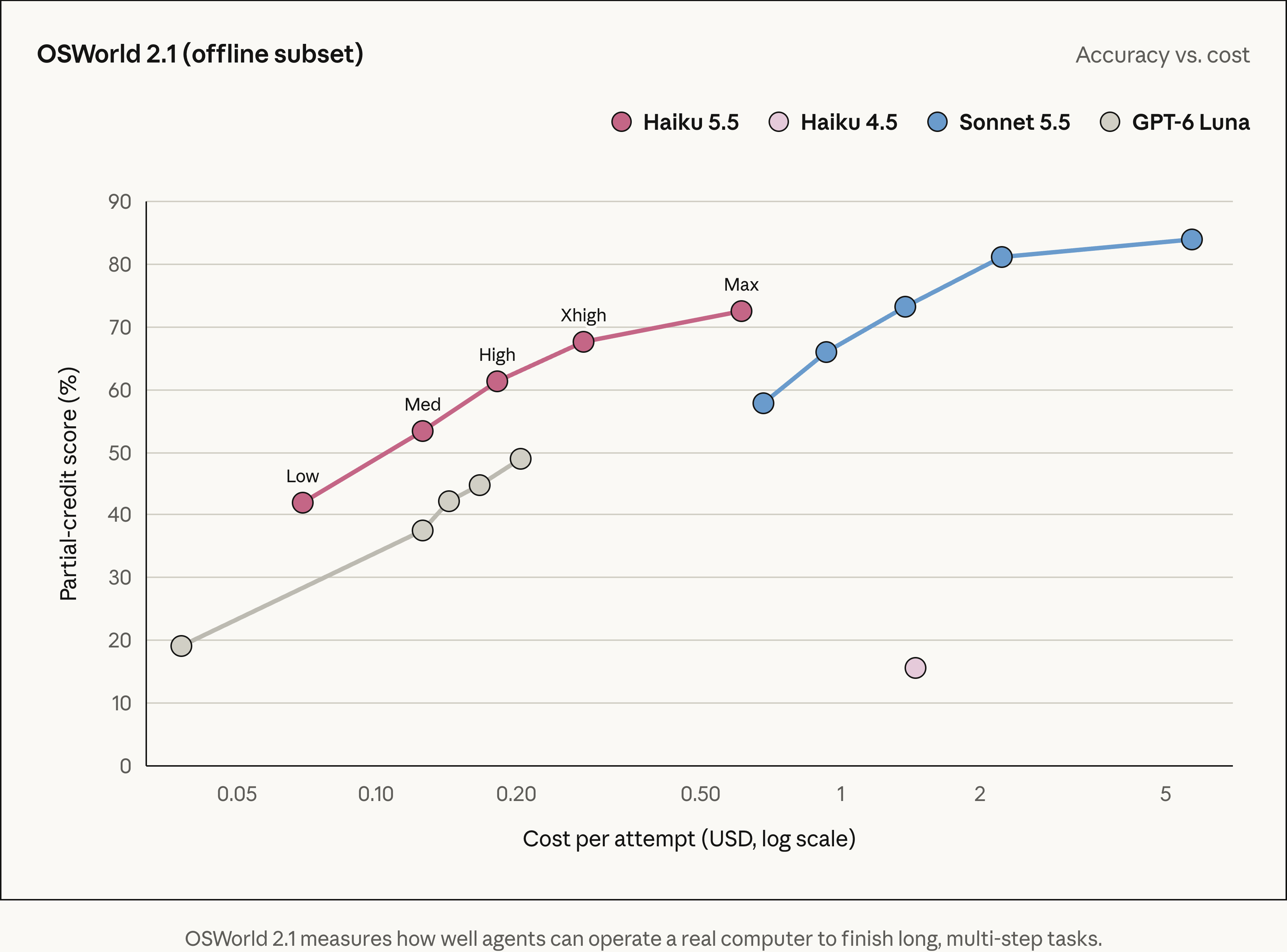
Source: Anthropic’s interactive chart, “Computer use: OSWorld” tab. All four model series remain visible; the evaluation is OSWorld 2.1’s offline subset.
The vertical axis is partial-credit score, not a count of fully successful requests. In the official UI, Haiku rises from 42.0% at Low to 72.4% at Max, while cost per attempt rises from about $0.07 to $0.61. Luna’s highest plotted point is 48.9% at about $0.20. The headline scores therefore compare different spending levels; the curve gives more context than the final score alone.
GDPval-AA: read the rating scale and the cost axis together
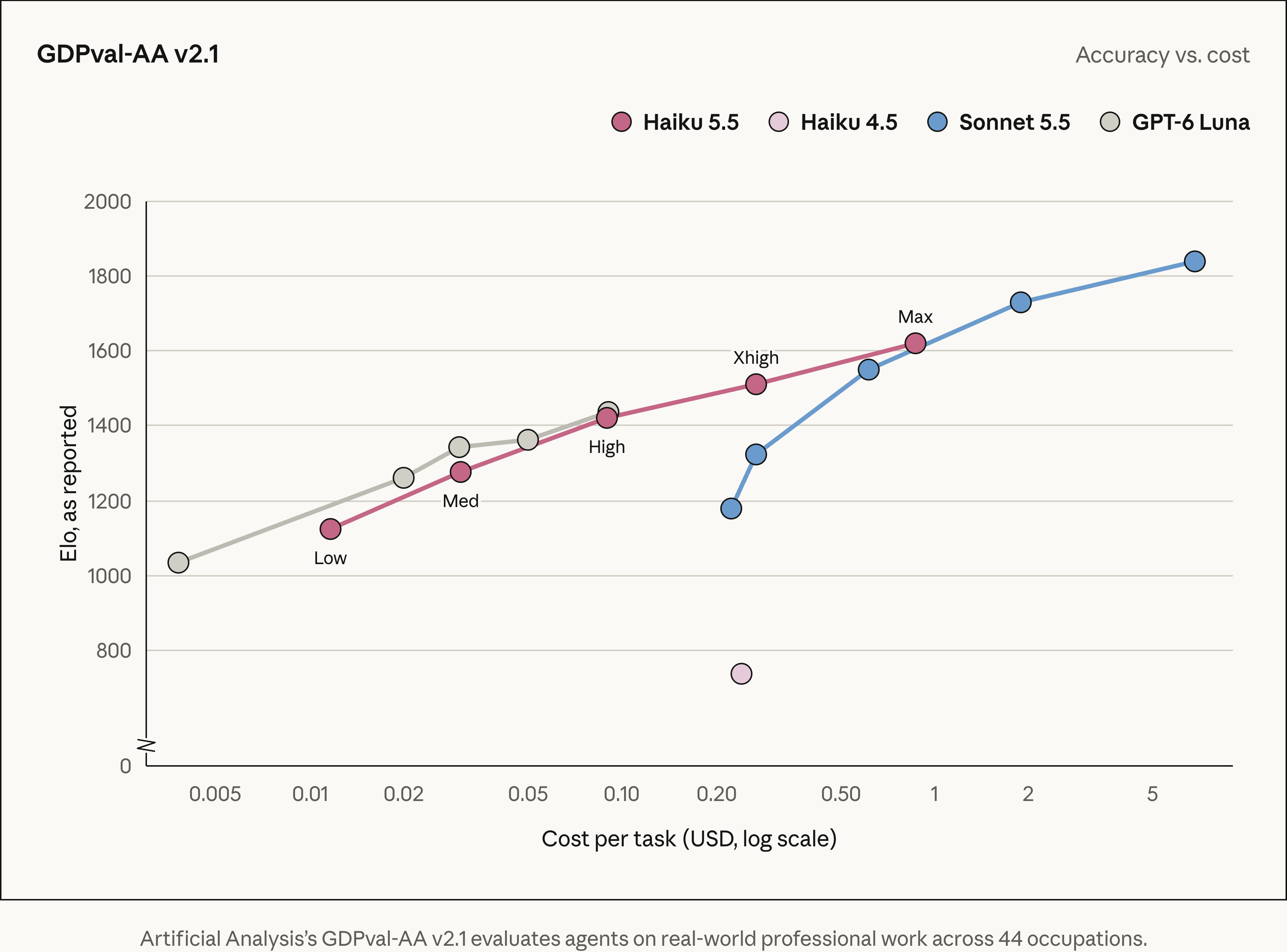
Source: Anthropic’s interactive chart, “Knowledge work: GDPval-AA” tab. The vertical axis is “Elo, as reported,” with a visible axis break; the horizontal axis is cost per task in USD on a logarithmic scale.
This evaluates professional work across 44 occupations. Haiku’s plotted results vary with effort, so the 1620 rating should not be treated as the outcome of every default request. Compare the model curves at the budget you can actually spend, and use tasks from your own occupation to check whether the ordering holds.
Terminal-Bench: keep the cache-price conditions attached
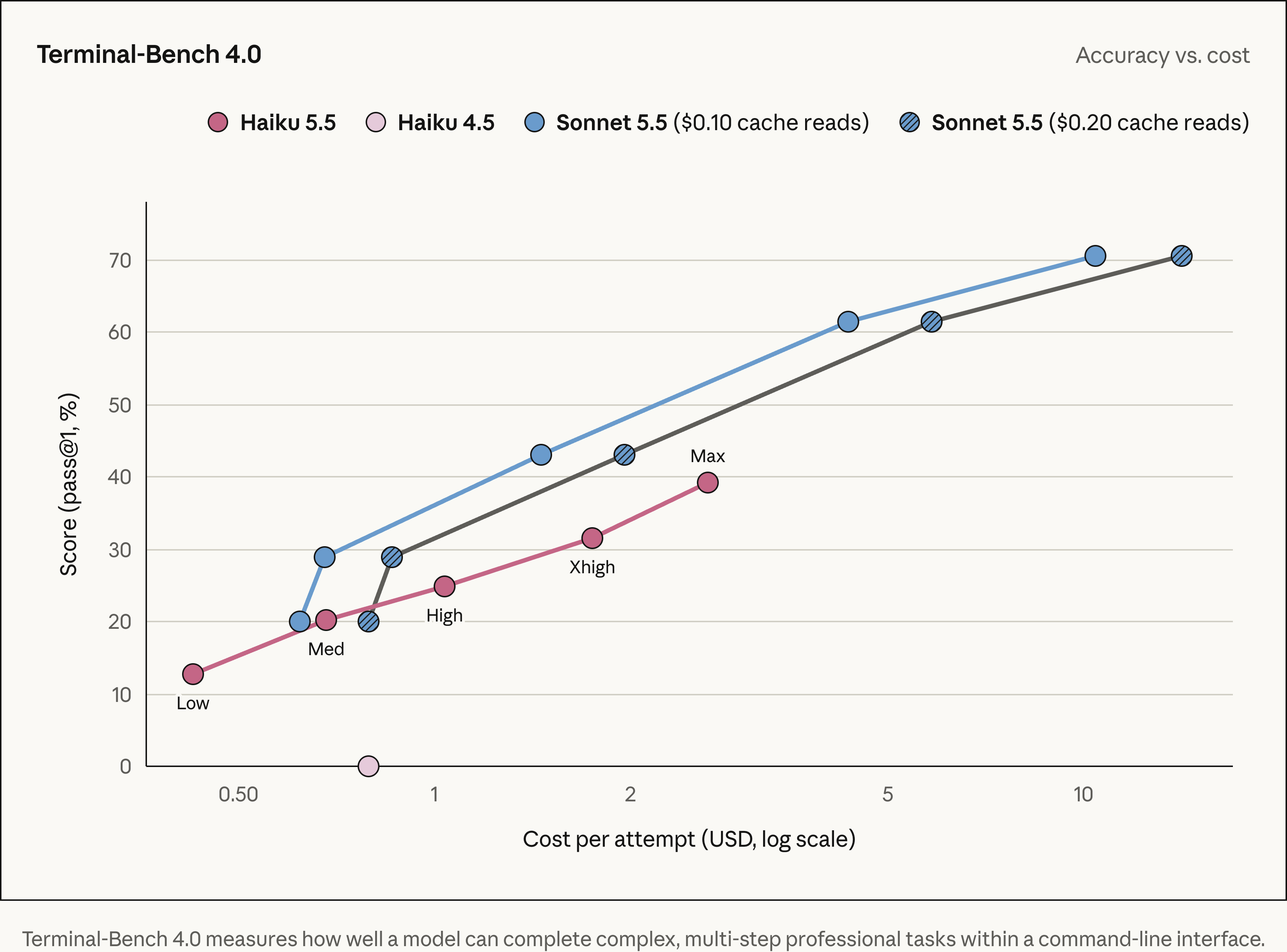
Source: Anthropic’s announcement, Further updates section. This chart includes Haiku 5.5, Haiku 4.5 and Sonnet 5.5 at $0.10 versus $0.20 per million cache-read tokens; it does not include a Luna curve.
The vertical axis is pass@1 score. The two Sonnet curves illustrate how changing cache-read prices shifts cost at the same performance level. They help explain why agent budgets depend on caching as well as model choice. For the Haiku–Luna coding comparison, use the original table above rather than assuming this chart measures Luna.
Effort settings and migration details
Haiku now lets developers adjust reasoning effort. The effort documentation sets its default to medium and exposes the control as output_config.effort. Lower effort can reduce token use, with a capability trade-off; it is a behavioral setting, not a hard spending cap.
Changing only the model name can leave old request assumptions behind. The Haiku model documentation says to omit temperature, top_p and top_k: non-default values return a 400 error. Its newer tokenizer also means old token budgets deserve another check.
Luna’s model reference has a different integration constraint: use the Responses API for built-in tools and function calling. Chat Completions supports function calling only with reasoning_effort set to none. A low-cost model name does not make the two providers’ request formats interchangeable.
For structured JSON combined with tools, Anthropic’s Haiku prompting guide recommends adaptive thinking or an appropriate tool-choice strategy. Include this combination in migration tests if your application depends on it.
Which model should you evaluate first?
An existing Claude workflow: start with Haiku on short, bounded jobs. Keeping the provider can reduce integration work, but rerun tool, tokenizer and output checks before replacing Haiku 4.5.
An existing OpenAI workflow: Luna remains a reasonable baseline. Matching starting prices removes one simple argument for switching; Haiku needs to earn the change through better completion quality or lower total task cost.
Prompts between 100,000 and 272,000 input tokens: test Luna’s pricing advantage first. Also try selecting relevant passages before calling either model. Sending fewer tokens helps only if the selection preserves the information needed to answer.
Long coding tasks: evaluate the orchestration, not just the small model. Assign bounded searches or checks to a small model and reserve broader changes for the model that passes your coding evaluations. Mengbi’s AI coding agents comparison covers the tools around that workflow.
A useful trial records completion quality, schema failures, missed tool calls, latency distribution, retries and escalation cost on the same labeled tasks. Include Chinese or mixed-language examples when those are real inputs. Measure cost per accepted result; a cheaper response that needs another model can be the more expensive workflow.
FAQ
Is Haiku 5.5 cheaper than GPT-6 Luna?
Their standard short-context input and output rates match. Haiku’s higher pricing starts above 100,000 input tokens, while Luna’s starts above 272,000. Actual cost also depends on tokenization, caching and retries.
Does Haiku 5.5 replace Sonnet or Opus?
Use it where your evaluation shows it can complete a bounded task. Stronger small-model benchmarks do not prove it can take over every complex task assigned to a larger model. Preserve escalation for work it cannot complete reliably.
Can I switch by replacing the model ID?
Check request parameters, reasoning controls, token budgets and tool behavior as well. Cross-provider migration additionally requires the appropriate API format. Validate the complete request and response path before changing production traffic.