

Claude Opus 5.5 is available now. In its September 22 announcement, Anthropic focuses on changes people can feel during a working day: stronger results on difficult tasks, lower costs and clearer replies.
For anyone using Claude to change code, review documents or draft a proposal, that is a useful combination. The immediate saving is concrete: input and output token prices are both down 20%. The larger question is whether the model also needs fewer attempts to finish work you can actually use.
This guide combines official documentation, independent Artificial Analysis results and screenshots of the source pages. Mengbi has not run paid API comparisons for this article. Vendor demonstrations, independent measurements and our interpretation are identified separately.
Claude Opus 5.5 at a glance
| Item | Confirmed detail |
|---|---|
| Release date | September 22, 2026 |
| Claude API model ID | claude-opus-5-5 |
| Context window | 1 million tokens |
| Standard maximum output | 128,000 tokens |
| Input and output | Text and images in; text out |
| Input / output price | $4 / $20 per million tokens |
| Cache reads | $0.20 per million tokens |
| Default effort | medium; adaptive thinking is always on |
| Developer access | Claude API, Amazon Bedrock, Claude Platform on AWS, Google Cloud and Microsoft Foundry |
These specifications come from the official model overview, checked September 23, 2026. A separate Batch API beta supports up to 300,000 output tokens. That is not the standard output limit.
Subscribers get a different change. Anthropic says it is increasing five-hour usage limits on Pro, Max and Team, and providing a rate-limit reset users can save for later. Lower API prices do not mean lower subscription fees, nor do they establish a fixed daily message allowance.
Pricing: three different kinds of savings
The headline “40% cheaper” needs a little unpacking.
Anthropic reports about 40% lower costs on typical workloads at default settings compared with Opus 5. That combines lower rates with changes in how many tokens a task needs. It is not a blanket 40% discount on every request.
| Billing item | Opus 5.5 | Opus 5 | Rate reduction |
|---|---|---|---|
| Uncached input | $4 | $5 | 20% |
| Output | $20 | $25 | 20% |
| Cache reads | $0.20 | $0.50 | 60% |
| Five-minute cache writes | $5 | $6.25 | 20% |
All prices are USD per million tokens, from the announcement and what's-new documentation. Opus 5.5 also lists one-hour cache writes at $8 and Batch input/output at $2/$10 for those processing modes.
Consider a task using 100,000 uncached input tokens, one million cached input tokens and 20,000 output tokens. Opus 5.5 costs $0.40 + $0.20 + $0.40 = $1.00. The same usage at Opus 5 rates costs $0.50 + $0.50 + $0.50 = $1.50, a saving of about 33.3%.
That example excludes cache writes and tool fees. It also assumes identical token usage, rather than giving the new model credit for efficiency it has not demonstrated on your task.
An agent repeatedly reading stable repository context could benefit more than a one-off question. Track the cost of an accepted result, including retries and review, rather than treating token prices as the whole bill.
Fast mode offers another trade-off: Anthropic advertises up to 2.5× speed at $8/$40 per million input/output tokens. Developer documentation describes it as a Claude API research preview; do not assume equivalent availability on every cloud platform.
Benchmarks show progress, with some clear exceptions
Anthropic's launch table gives Opus 5.5 66.4% on Terminal-Bench 4.0 and 57.8% on CursorBench 4.0. These cover multi-step terminal work and coding across files, making them relevant to people using agents beyond small function-writing exercises.
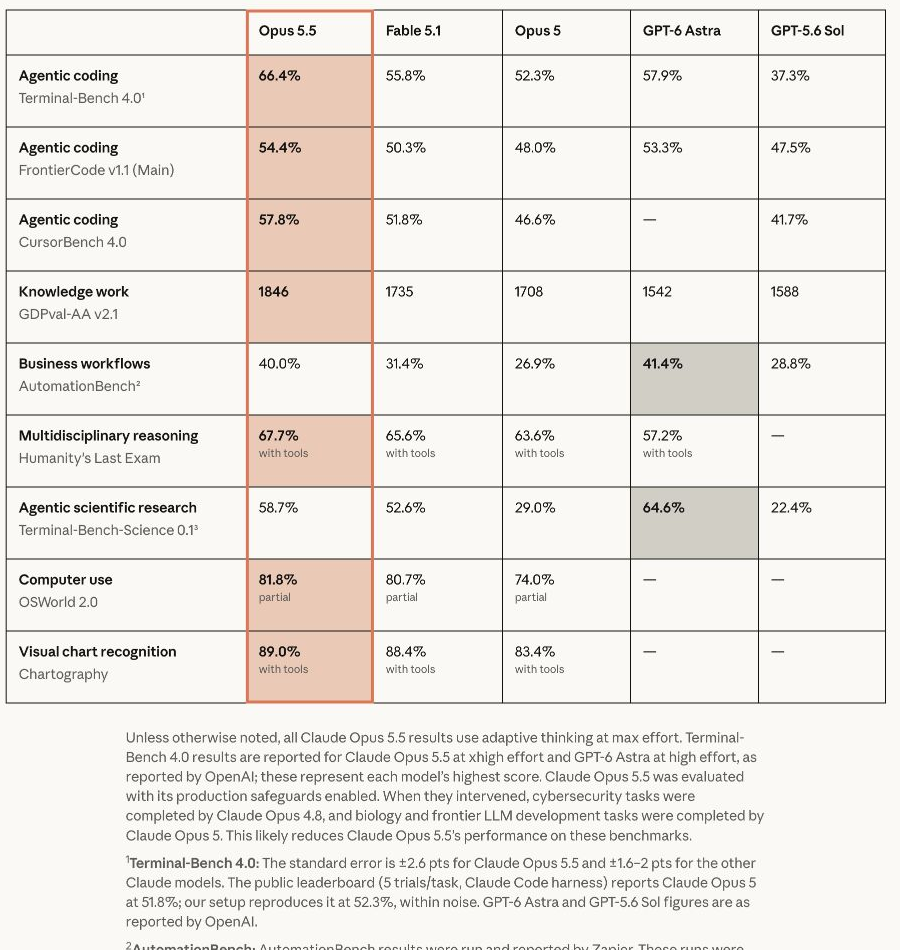 Actual screenshot of Anthropic's launch page, captured September 23, 2026. This is a vendor-published comparison; conditions are explained below and in the original footnotes.
| Evaluation | Opus 5.5 | Opus 5 | What the number describes |
|---|---|---|---|
| Terminal-Bench 4.0 | 66.4% | 52.3% | Multi-step command-line tasks |
| CursorBench 4.0 | 57.8% | 46.6% | Ambiguous, multi-file coding tasks |
| GDPval-AA v2.1 | 1846 Elo | 1708 Elo | Relative professional-work rating, not accuracy |
| AutomationBench | 40.0% | 26.9% | Cross-app workflows; results run and reported by Zapier |
| OSWorld 2.0 | 81.8% | 74.0% | Partial completion, not end-to-end task success |
Most Opus 5.5 results use maximum effort. Terminal-Bench uses xhigh, with a reported standard error of ±2.6 percentage points. Some sensitive tasks were completed by fallback Claude models after safeguards intervened. Zapier's AutomationBench runs used no fallback and counted interventions as failures.
The same table also shows limits to the lead. GPT-6 Astra scores 41.4% on AutomationBench versus 40.0% for Opus 5.5, and 64.6% on Terminal-Bench-Science versus 58.7%. A claim that Opus wins every kind of work would go beyond the evidence.
What independent testing adds
The Artificial Analysis model page displayed an Intelligence Index score of about 58, ranked 1 of 661, when checked on September 23. Its full configuration is Adaptive Reasoning, Max Effort, Default Fallback.
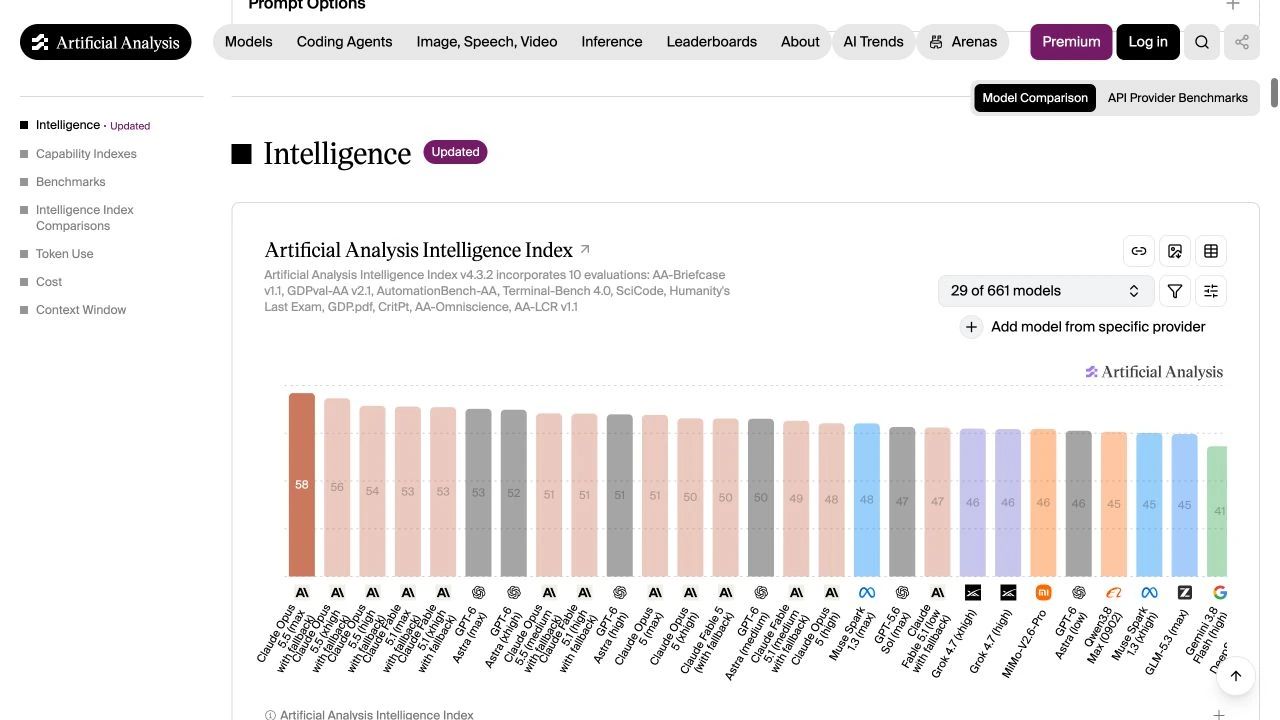 Screenshot of Artificial Analysis, September 23, 2026. The chart displays a selected subset of model configurations; rankings can change.
Version 4.3.2 combines ten evaluations. This provides evidence beyond Anthropic's own comparison: the model also performs strongly in an independent suite. However, 58 is an index score, not 58% accuracy. A maximum-effort result with fallback is also not a measurement of the default medium configuration in isolation.
Some launch-day fields were incomplete. Speed and task cost showed N/A, while the pricing summary displayed $0.00. We did not use those price fields; this guide uses Anthropic's documented rates. New leaderboard entries can be useful before every field has caught up.
Less rework is the improvement worth testing
Repository migrations, audits and changes across modules are sensible starting points. They require a model to gather context, make coordinated edits and learn from failed tests. Anthropic's selected early-user reports describe fewer steps, fewer tokens and less rework, but they are not delivery-time guarantees for your codebase.
A useful trial is a recent change your team has already completed. Fix the repository version, give both models the same request and compare their work. Check for altered business behavior and weakened tests, as well as whether the test suite passes.
Clearer explanations matter too. If an agent buries the problem under three screens of analysis, someone still has to find it before approving the change.
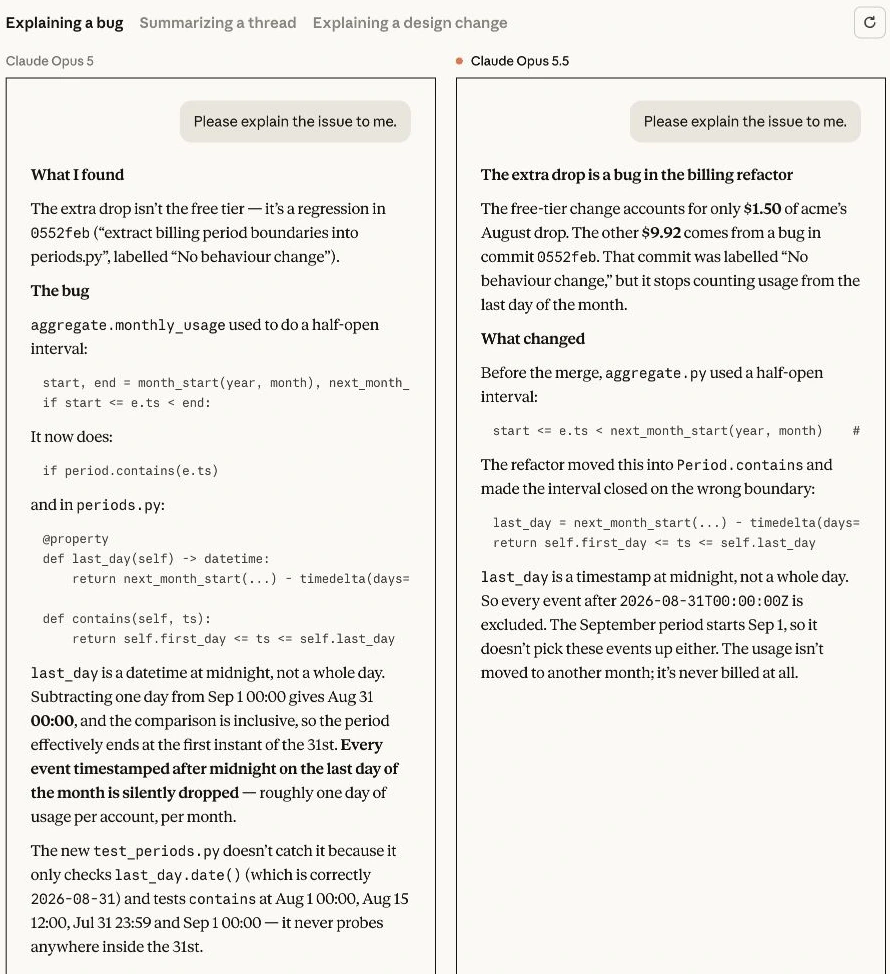 Screenshot of the official Communication demonstration. This is the launch page's interactive example, not a test Mengbi ran in a signed-in Claude account.
In this example, Opus 5.5 starts by separating a billing error from an expected pricing change. It then explains the date-boundary mistake. The reader learns the impact before having to work through the code.
That is a useful editorial improvement, but one selected example cannot establish writing quality across languages. To test it properly, use a document you would publish: a customer email, a product explanation or a technical update. Check whether it preserves the facts and your voice without adding confident claims you never supplied.
API migration needs more than a new model name
The model ID is claude-opus-5-5. Before updating an existing integration, review the official compatibility changes:
- Thinking cannot be disabled. Disabled thinking and manual
budget_tokensconfigurations return 400. Omit the thinking field or useadaptive, then control effort withoutput_config.effort. - Forced tool choice is unsupported. The
anyandtoolforms oftool_choicereturn errors. Review workflows that depend on them. Strict tool arguments or structured outputs address schema validity; they do not automatically require a tool call. - Thinking blocks are bound to their model and preceding conversation. For accounts created from August 31, 2026, replaying them after editing earlier prompts, tools or messages can trigger an error. Follow the documented preservation or dropping rules.
- Older computer-use integrations need attention. Claude API and Google Cloud require
computer_toolset_20260801instead ofcomputer_20251124. Bedrock has different compatibility behavior. - Progress updates move into thinking blocks. Their text is omitted by default. An interface that only streams text blocks can appear to stop reporting progress between tool calls.
The default effort also changes from Opus 5's high to medium. Set it explicitly during comparisons, and remember that the same effort label does not promise the same token use.
Handle refusals separately from HTTP success. A direct API response may return HTTP 200 with stop_reason: "refusal". Your application needs to recognize that outcome and apply supported fallback behavior; a successful request is not necessarily completed work.
Who should try it first
Teams already using Opus 5 for demanding coding or analysis have a good reason to run a small comparison. Lower input, output and cache-read rates are documented, and the independent results are encouraging. Compatibility and reduced rework are the parts you need to establish locally.
For short classification, routine extraction or simple questions, compare against the cheaper model already meeting your acceptance criteria. A flagship is not automatically the most economical choice.
Start with three jobs: a code change with meaningful tests, an analysis whose sources can be checked and a writing task with a clear style brief. Record accepted results, elapsed time, cost and human edits. Those measurements give you a better basis for wider adoption than a leaderboard position alone.
For more context, see the Claude tool profile, our Fable 5.1 guide or the AI coding agents comparison.
FAQ
When was Claude Opus 5.5 released?
Anthropic's release date is September 22, 2026. This article was verified on September 23 in China Standard Time.
How much does the Claude Opus 5.5 API cost?
Standard input costs $4 per million tokens, output costs $20 and cache reads cost $0.20. Cache writes, Batch processing, Fast mode and tools have separate billing rules.
Is Opus 5.5 really 40% cheaper than Opus 5?
That is Anthropic's reported reduction for typical workloads at default settings. Input and output rates fall 20%, while cache-read rates fall 60%. Actual task costs depend on usage, cache hits and retries.
Is Opus 5.5 better than Fable 5.1?
Anthropic describes comparable performance on most work and reports several higher benchmark scores. Independent results are also strong. Neither source guarantees better results on every task, especially across different effort and fallback settings.
How large is the context window, and can it generate images?
The documented context window is one million tokens, with 128,000 standard maximum output tokens. It accepts text and images and produces text; it is not a native image-generation model.
Are Sonnet 5.5 and Haiku 5.5 available too?
The announcement says they will follow in the coming weeks, without giving exact dates. Opus 5.5's launch does not establish availability of the whole family.
Sources and review scope
- Anthropic launch announcement: product changes, vendor evaluations and selected early-user reports.
- Official model overview: specifications, prices, modalities and platforms.
- What's new and compatibility guidance: request changes, thinking, tools and fallback.
- Artificial Analysis model results: independent index and configuration.
- Artificial Analysis index explanation: index composition and interpretation.
Last verified: September 23, 2026. Body screenshots come from the credited live pages. Rankings, availability and documentation may change after this snapshot.