
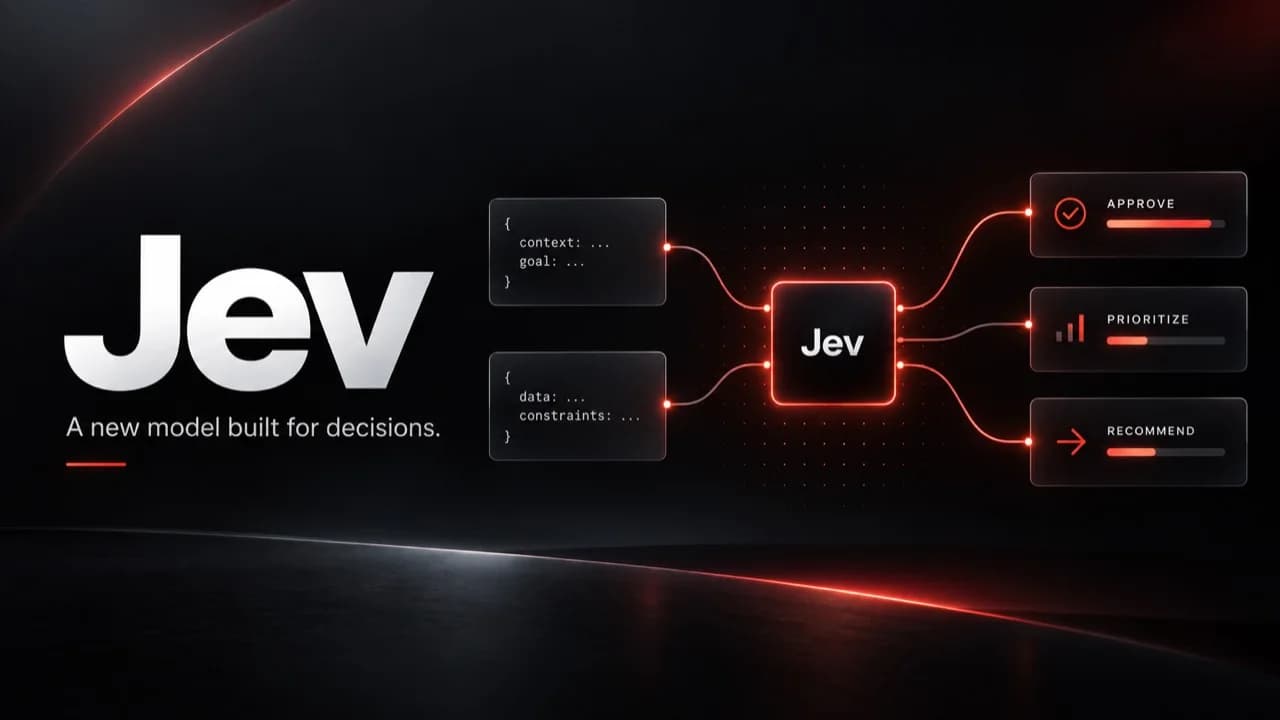
Jev is interesting because many AI calls end in a small decision: choose a team, score an issue, or flag a missing requirement. Generating a paragraph can be unnecessary when software only needs one of those answers.
TypeSafe calls this category System One models. This review separates product documentation, vendor benchmarks, and Every’s hands-on observations. Mengbi has not run its own Jev API benchmark. Sources were checked on September 18, 2026; the is dated September 14, so this is a launch-week review rather than a claim that Jev first appeared today.
What is Jev?
The describes a model that accepts state and typed questions, then returns results software can use directly. Think ticket routing or checking a response against a requirement. Writing an essay or generating application code is a different job.
| Primitive | Result | Example job |
|---|---|---|
| Choice | Selected option, probabilities and confidence | Route a support ticket |
| Score | Position on a rubric, probabilities and confidence | Grade issue severity |
| Noul | Probability that a statement is true, from 0 to 1 | Check whether a refund was requested |
A Noul value of 0.5 means uncertainty between yes and no, not medium severity. Use a defined Score rubric for severity. The also distinguishes independent questions from questions that depend on earlier answers; the latter require explicit orchestration.
Our suggested editorial use would be to split “should we publish this?” into checks for missing evidence, unsupported conclusions and title/body mismatch. That makes each result easier to inspect. It is a proposed workflow, not a demonstrated accuracy claim.
Jev API pricing
lists $42 per billion input tokens: $0.042 per million input tokens. Its launch announcement says outputs are unmetered. These are the terms checked for this review, not a guarantee of future pricing.
For an illustrative budget, one million requests with 2,000 total billable input tokens each would consume two billion input tokens and cost $84 in model input charges. The calculation excludes retries, storage, tools and any subsequent model calls.
The useful question is whether cheaper checks improve the workflow enough to justify their false alarms and misses. Running a check more often does not automatically make the resulting automation more reliable.
What the official benchmark actually measures
TypeSafe reports 70–500 ms end-to-end responses and headline workflow gains of 193.6× in speed and 444.6× in cost. These are vendor results under particular conditions, not a universal SLA.
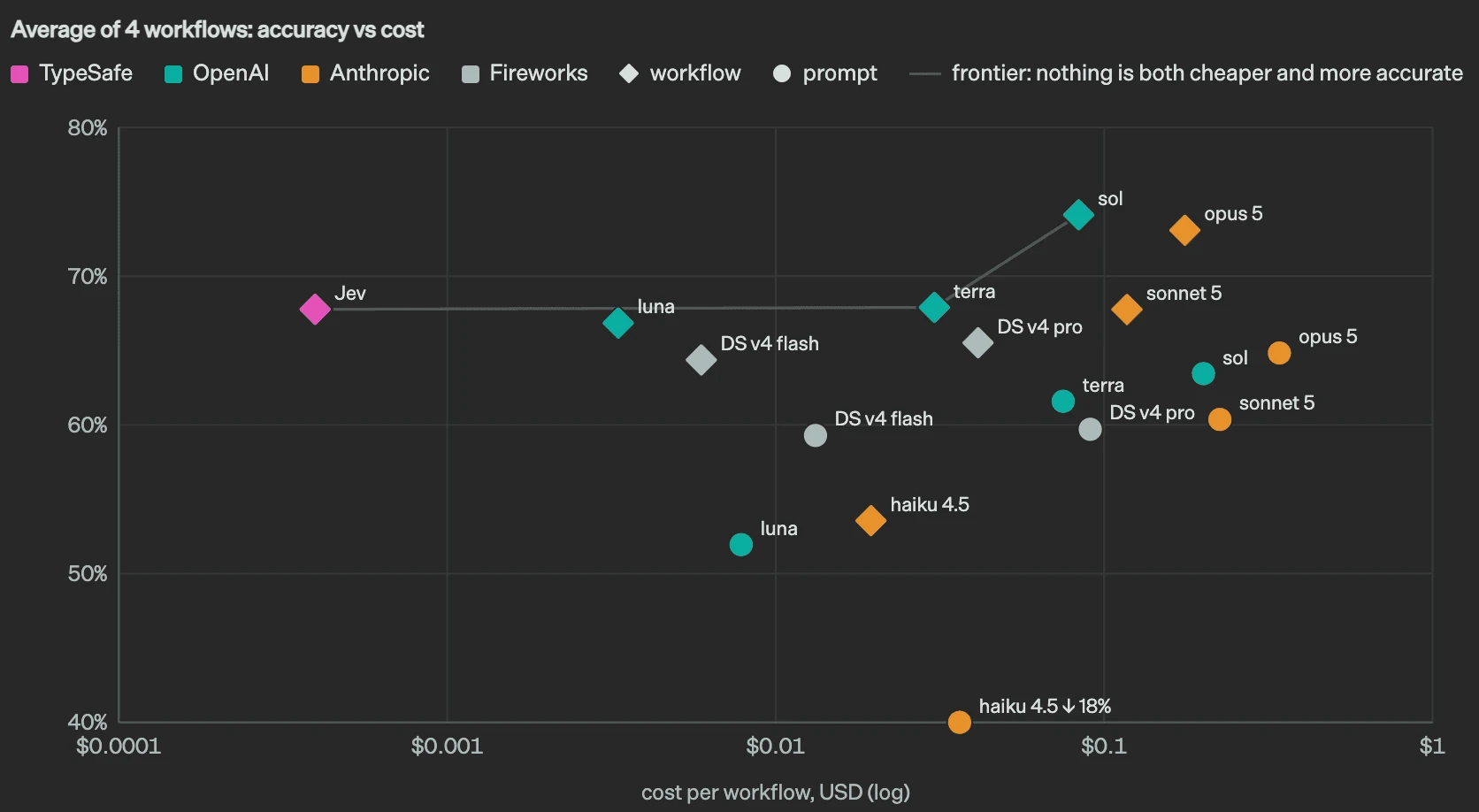
Source: . Original model labels are retained. Diamonds and circles represent different execution methods.
The reports 67.8%, approximately $0.0004 per workflow and 0.4 seconds for Jev in its four-workflow aggregate. Its reference is the averaged predictions of GPT-6 Astra and Fable 5.1, not independently established human ground truth. The percentage must therefore remain attached to that evaluation definition.
TypeSafe discloses that its team created the workflows and its LLM comparisons use a structured-output wrapper. Both matter when interpreting cost and latency. Compare identical output requirements before assuming your application will reproduce the headline multiples.
Third-party tests: fast checks with a visible miss
tested 27 articles and 10 deliberately AI-styled counterparts against 21 questions: 777 judgments in under 0.7 seconds, at an estimated $0.0025. That demonstrates a fast checking workflow, not reliable proof of AI authorship.
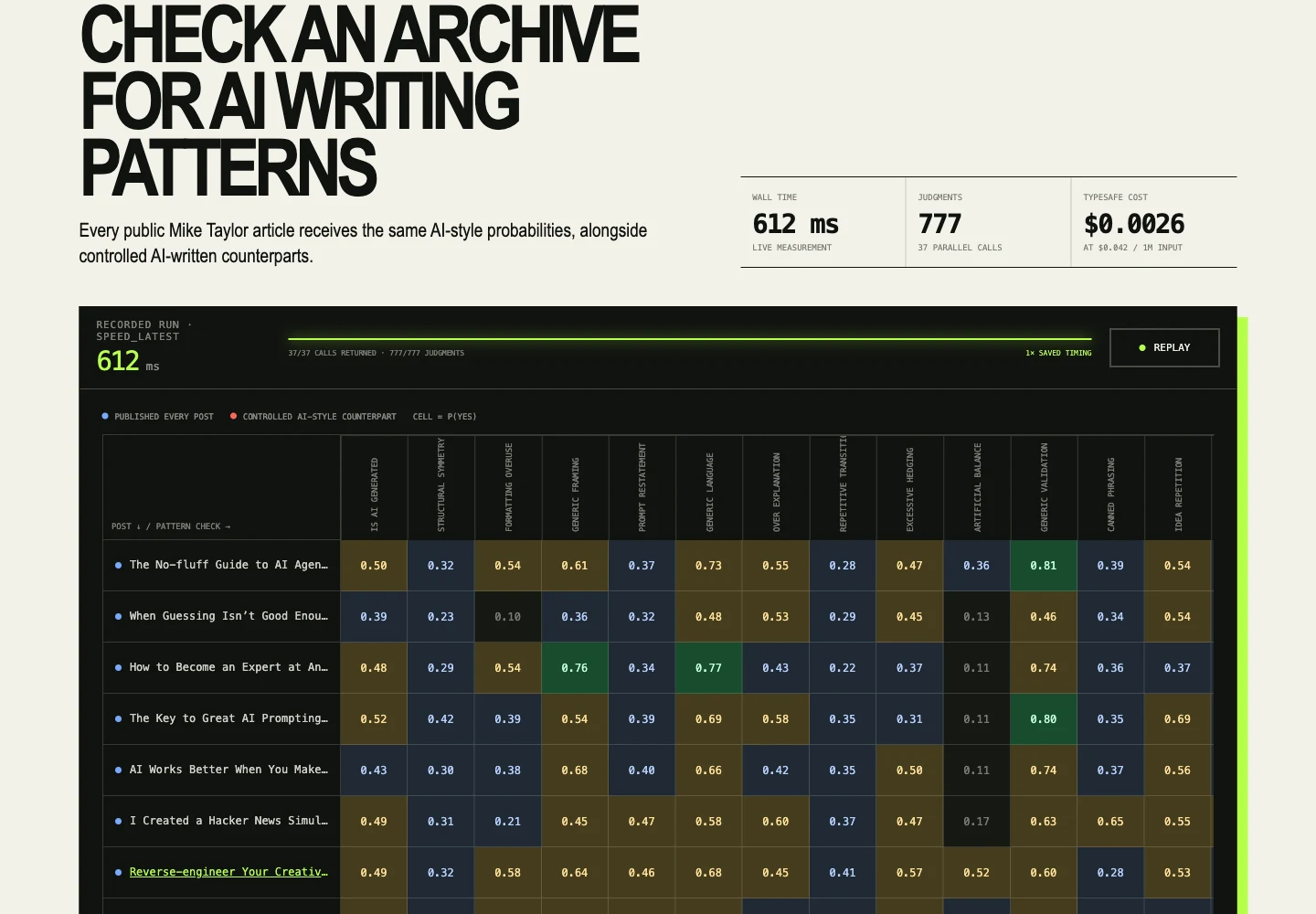
Captured September 18 from the . This replays saved results; it is not a fresh Mengbi API run. The page labels its measurement date August 28, which differs from the article’s publication date. This saved run shows 612 ms and $0.0026; the paragraph above retains the article’s approximate cost wording.
Every also describes four checks over 12 synthetic passages containing seven intended defects:
| Measure | Jev | Fable 5.1, high effort |
|---|---|---|
| Median time per passage | 0.35 seconds | 8.83 seconds |
| Intended defects caught | 6 of 7 | 7 of 7 |
| Estimated cost | About 580× cheaper, per Every | Comparison baseline |
This is a useful trade-off, not a general accuracy leaderboard. Seven defects are too few to establish broad reliability, and these results do not establish performance on Chinese, mixed-language or specialist content.
Type safety does not mean correct decisions
A model constrained to options A, B and C can still choose A when B is correct. Preventing malformed output solves an integration problem; it does not eliminate classification errors.
The adds a practical distinction: Choice and Score confidence is a statistic derived from the probability distribution, while Noul has no separate confidence field. Do not interpret a confidence value of 0.9 as a verified 90% correctness rate for your business decision.
Record predictions alongside later human judgments before setting automatic-action thresholds. A threshold copied from a demo is not a substitute for calibration on your own workload.
How to try Jev
Access remained early-access and waitlist-based when checked. The points approved users to the Playground and the POST /v1/systemone on api.typesafe.ai endpoint, with model ID jev-latest. It has its own request structure; having an API does not imply drop-in Chat Completions compatibility.
Start with a bounded task whose errors you can inspect:
- Collect normal, clearly wrong and ambiguous examples in the languages you actually use.
- Define the judgment before labeling the examples, including an uncertain outcome.
- Compare Jev and the existing method against the same human labels. Track false positives, false negatives and latency distributions.
- Run in observation mode before allowing decisions to trigger consequential actions.
For developers, candidate filtering or individual response checks are sensible experiments. Keep a generative model for writing code and explanations. Mengbi’s covers that broader execution role.
FAQ
Can Jev replace ChatGPT or Claude?
Its typed decisions suit classification, scoring and checks. Open-ended conversation, writing and code generation still require a model designed for those outputs.
Does Jev really have zero hallucinations?
Type-safe output should not be confused with zero judgment errors. Every’s small test includes a missed defect. Validate the decisions your application will actually rely on.
Is Jev worth integrating now?
It is worth a trial for frequent, bounded judgments with reviewable outcomes. The current evidence does not establish that it should replace a general-purpose assistant. Check the , then measure the task you need rather than adopting the headline benchmark as your forecast.