
The first thing to check with Gemini 4 Argon is whether you can actually use it. A launch chart can tell you where to investigate. It cannot grant access to your project, explain every billing condition or prove that your existing agent will work after a model swap.
This review brings together Google’s announcement, its evaluation methodology and independently measured Artificial Analysis results, checked on October 1, 2026. We did not run a separate controlled model experiment. Reported measurements are attributed; the migration advice is our editorial judgment.
October 14 update: Access, the model ID, pricing and unified token limits have been updated. Launch evaluations and charts below retain their original measurement date. See the Argon rollout and API guide for setup and product-specific access.
What is Gemini 4 Argon, and is it available now?
Google announced Argon on September 30, 2026 for demanding coding, professional and defensive security work. The initial release was controlled; the October 13 Gemini app announcement now confirms Pro and Ultra access.
App subscriptions, AI Studio and API projects still have separate conditions. For an integration, check project billing rather than applying the app's Pro entitlement to the API.
The catalog had no Argon entry when we checked on October 1. The official model page and pricing page now document it. The stable model ID is gemini-4-argon, available on the paid API tier.
Our rollout supplement covers request examples, background long decode and cache migration. This review continues to focus on evaluation and model selection.
If you need a working Gemini integration immediately, our Gemini 3.8 Flash API guide covers the separate, documented model. Keep its access conditions separate from Argon’s.
Gemini 4 Argon pricing: budget beyond the launch discount
The published API price sheet gives standard rates in USD per million tokens. Introductory pricing runs through November 30, 2026, with regular rates starting December 1.
| Charge | Introductory price | After the introductory period |
|---|---|---|
| Uncached input | $2 | $4 |
| Output, including thinking | $10 | $20 |
| Input served from implicit cache | $0.10 | $0.20 |
Source: Google API pricing. Argon supports implicit caching only, and the discounted input rate applies to actual cache hits. Check tool and other additional charges separately.
A simple estimate makes the promotion easier to understand. Assume a request bills 100,000 uncached input tokens and 10,000 output tokens, with no other charges. Its introductory cost is $0.30: 0.1 × $2 + 0.01 × $10. The same token counts at the announced later rates cost $0.60. With those input tokens charged as cache hits, the introductory total would be $0.11, excluding any separate cache cost.
For a trial, record both today’s bill and a second estimate at the post-promotion rates. Otherwise a pilot can appear economical because of a temporary price, then lose that advantage without any change in model quality.
Token price also leaves out repeated attempts. A useful budget divides total model spend—including unsuccessful runs—by the number of accepted outcomes. Track review time alongside that figure. A cheap patch that needs extensive repair is a different purchase from a cheap patch you can merge.
Official benchmarks: strong results with clear exceptions
The DeepMind comparison table shows a mixed capability profile. Below are selected rows, rather than an average of incompatible percentages.
| Evaluation | Argon | GPT-6 Astra | Claude Opus 5.5 |
|---|---|---|---|
| Vals Index | 68.9% | 63.1% | 67.0% |
| DeepSWE v1.1 | 77.9% | 74.1% | 74.2% |
| FrontierSWE v2 | 55.0% | 65.5% | 62.3% |
| Terminal-Bench 4.0 | 57.4% | 58.2% | 66.4% |
| AutomationBench | 51.3% | 41.4% | 42.5% |
| GraphWalks, 256K–1M, BFS F1 | 84.2% | 71.8% | 66.8% |
| LVBench | 91.7% | 87.5% | 83.7% |
These rows come from Google’s published compilation. Some are Google-run experiments and others come from external evaluators. They are not one independent replication under identical conditions.
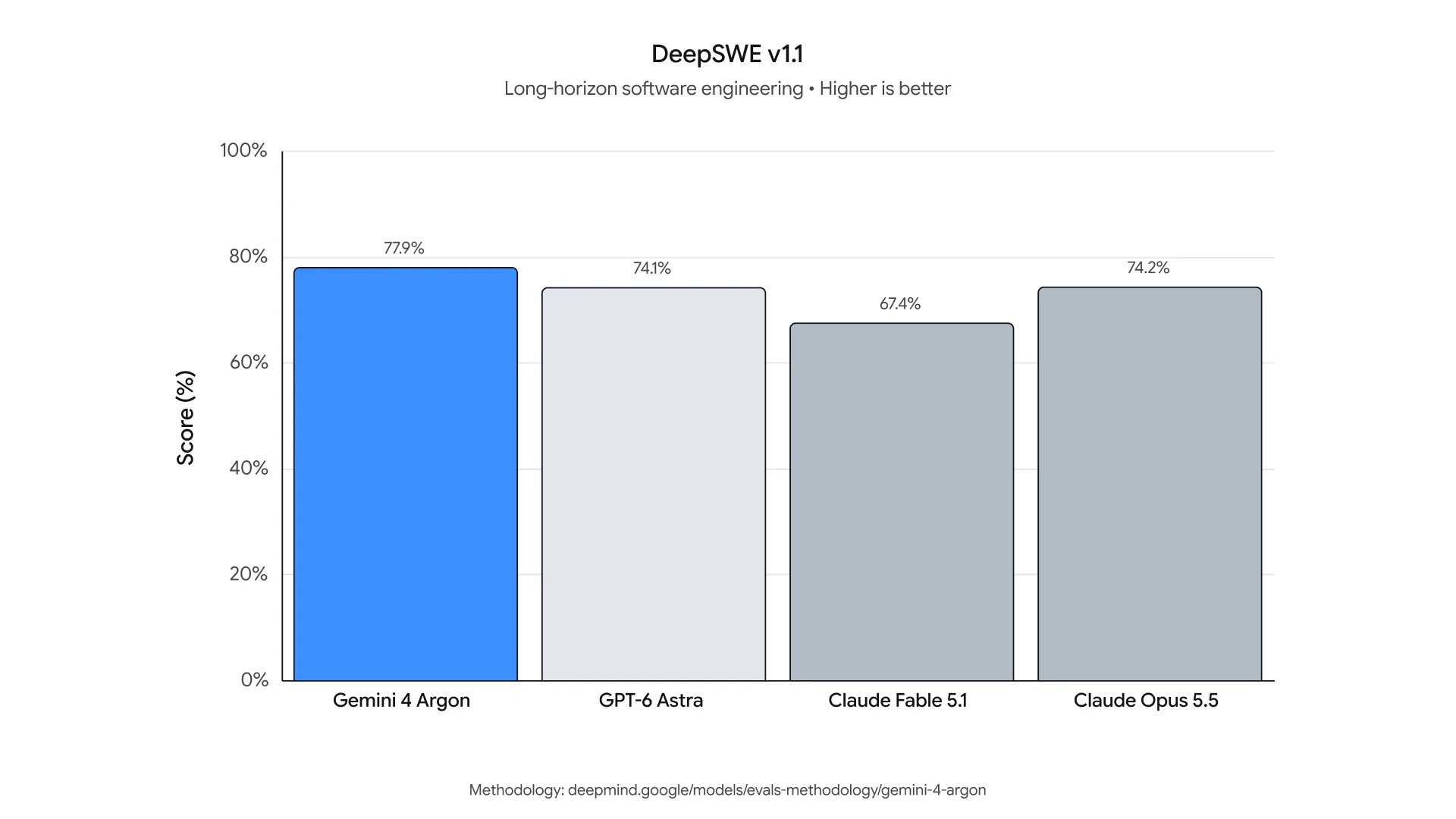 Official launch chart from Google. The agent harness and reasoning settings are part of the result.
For repository work, the contrast between DeepSWE and FrontierSWE is the useful finding. Argon looks promising on one collection of engineering problems while Astra leads on another. A leaderboard win does not settle which model will understand your build system, locate a regression or preserve an undocumented requirement.
The evaluation methodology explains several conditions worth retaining: Argon usually uses the highest thinking setting and pass@1; Google computed its DeepSWE result with a mini-swe harness; video evaluations used different frame budgets across models. The OSWorld offline result is a partial score, with its own run-selection rule. Those differences matter when interpreting a headline.
For long documents, GraphWalks is a reason to test dependency tracing across a large input. It is not a measurement of every legal memo, spreadsheet or RAG system. For video, test whether the model identifies the relevant moment and supports its answer with the correct timestamp. More frames and a better benchmark score do not remove the need to inspect the evidence.
Independent tests: the cost advantage depends on the comparison
Artificial Analysis’s launch evaluation puts Argon at high reasoning at 53 on Intelligence Index v4.3.2. It matches Astra at max on that composite index and sits one point above Sol 6.1 at max. These are index points, not answer-accuracy percentages.
Its launch task cost is $1.99, versus $3.26 for Astra and $0.72 for Sol 6.1. At unchanged token use, applying the later rates would bring Argon to $3.98. That is a pricing scenario for this benchmark mix, not a prediction of your production workload.
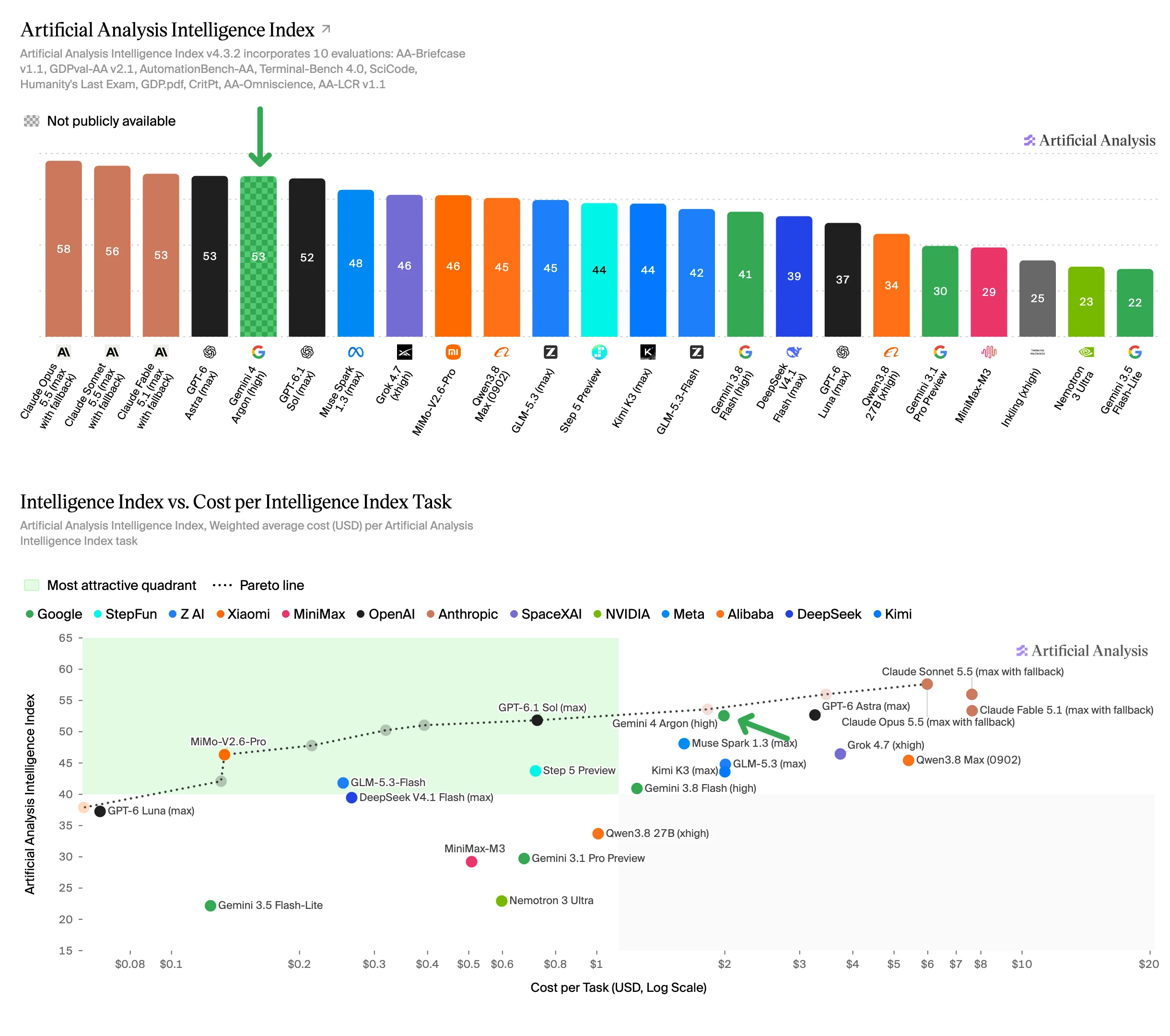 Independent launch charts from Artificial Analysis. Availability reflects the launch snapshot; see the current access section above. Reasoning and fallback configurations remain visible.
The comparison changes the purchasing decision. Argon is an attractive trial against an expensive Astra workflow at the promotional rate. Against Sol 6.1, a small composite-score gain comes with a materially higher benchmark bill. Our Sol 6.1 review explains why effort settings and accepted-result costs deserve their own tests.
Independent agent tests also show why the task matters. The AutomationBench-AA evaluation reports 77.5% for Argon’s displayed high setting. Its headline score measures the share of objectives completed, with any guardrail violation reducing that task’s score to zero; it is not the percentage of tasks completed in full. That distinction helps explain why it should not be read as the same measure as the 51.3% AutomationBench row in Google’s table. Evaluator, setup, dataset and scoring rule must travel with the number.
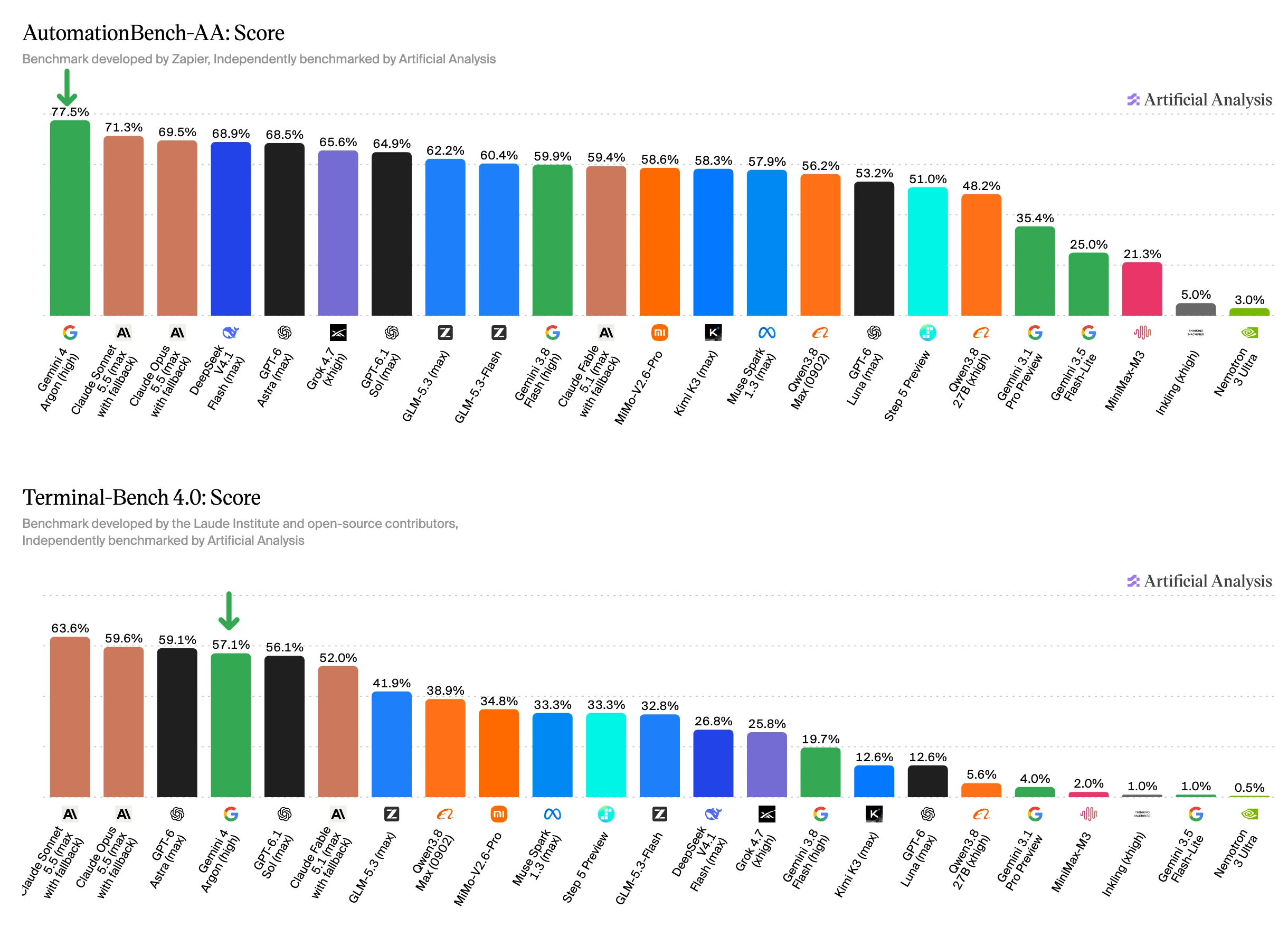 Independent agent results from Artificial Analysis. This figure helps distinguish its SaaS-workflow evaluation from Google’s compilation.
The model page reports 110 million output tokens across its Intelligence Index evaluation and no measured public output speed. Long reasoning may help finish a problem, but you still need to measure waiting time and cancellation behavior. It would be misleading to call Argon “fast” from the information available here.
A million output tokens changes the engineering problem
The updated model documentation defines one 1,048,576-token window shared by input, thinking and output. Normal synchronous requests stop at 65,536 tokens. Generating beyond 64K requires background long decode and a larger output budget.
Our practical concern is how to recover a long run. If an answer takes many continuation steps, can your application reconnect, preserve progress and avoid repeating a tool action? Artificial Analysis used Long Decode Continuation for its launch evaluation. The official long decode guide now documents background parameters, continuation and how to combine output steps.
A longer ceiling is valuable when a task needs it. It can also produce a larger bill or a lengthy investigation that misses the acceptance condition. Start with a constrained artifact: a patch and its checks, a memo with source references, or an exported file with validated formulas. Set time and spending limits before letting the model pursue a difficult task.
Reliability and cybersecurity: keep the conditions attached
Artificial Analysis reports 15% hallucination rate and 50% accuracy on AA-Omniscience for Argon high. These two percentages have different denominators. Its metric definition defines accuracy over all questions, while hallucination rate is incorrect answers divided by incorrect, partial and unattempted responses combined. “15% hallucination” does not mean “85% of everything it writes is correct.”
For document work, that suggests testing how the model handles absent evidence. Give it a report with a deliberately missing figure and ask for a referenced conclusion. Check whether it says the evidence is unavailable, invents a number or quietly changes the question. Repeat in the language your team actually uses; these benchmark figures do not establish Chinese writing quality.
The Fairwind Program is a controlled route for defensive security access. Google’s launch announcement distinguishes trusted defenders’ cyber configuration from broader release safeguards. It does not promise that ordinary API customers will receive the same configuration or that prompt injection is solved.
For an engineering team, the acceptance rule should include patch correctness, regression checks and a human review boundary. Keep secrets out of retrieved material and restrict what tools can do. A more capable model can find more useful work; it can also make a mistaken action more consequential.
How we would evaluate a migration
Keep the existing model in production while the candidate earns its place. Our proposed trial has three parts:
- Repository issue: give both systems the same known failure, repository state and checks. Accept a patch only if it fixes the issue and preserves the tested behavior. Record retries and review time.
- Professional document: use the same PDF, table or chart. Ask for a decision memo with source locations and one explicit missing fact. Inspect units, dates and unsupported claims rather than scoring fluent prose.
- Multi-step workflow: request a real saved artifact with limited permissions. Verify the final record or export, then test interruption and recovery. Measure total spend at both promotional and later rates.
Hold the harness, tools and permissions as constant as possible. If you change those alongside the model, record the comparison as a system change. Keep an escalation path for tasks where the candidate cannot finish. Our Astra API guide is relevant when that alternative remains in the evaluation.
Argon has enough evidence behind it to deserve this trial. A production switch becomes justified when it produces better accepted results—or the same acceptable results at a cost your team can sustain after the discount ends.
FAQ
Can I use Gemini 4 Argon for free or with Google AI Pro?
The October 13 announcement confirms Pro and Ultra in the Gemini app; the API pricing page excludes the Free tier. AI Studio, Antigravity and API access differ. See the product access table.
What API model ID should I put in my code?
The official model page now confirms the stable ID gemini-4-argon. Check your paid project and account permissions before calling it.
Does 1M output mean I can send 1M input tokens too?
Input, thinking and output share one 1,048,576-token window. You cannot fill both input and output with a million tokens at once. Synchronous output is capped at 64K; longer generation needs background long decode.
When does the introductory API price end?
The published price sheet specifies November 30, 2026 as the last day. From December 1, standard API rates are $4 input, $20 output and $0.20 implicit cached input per million tokens. Output billing includes thinking tokens.